
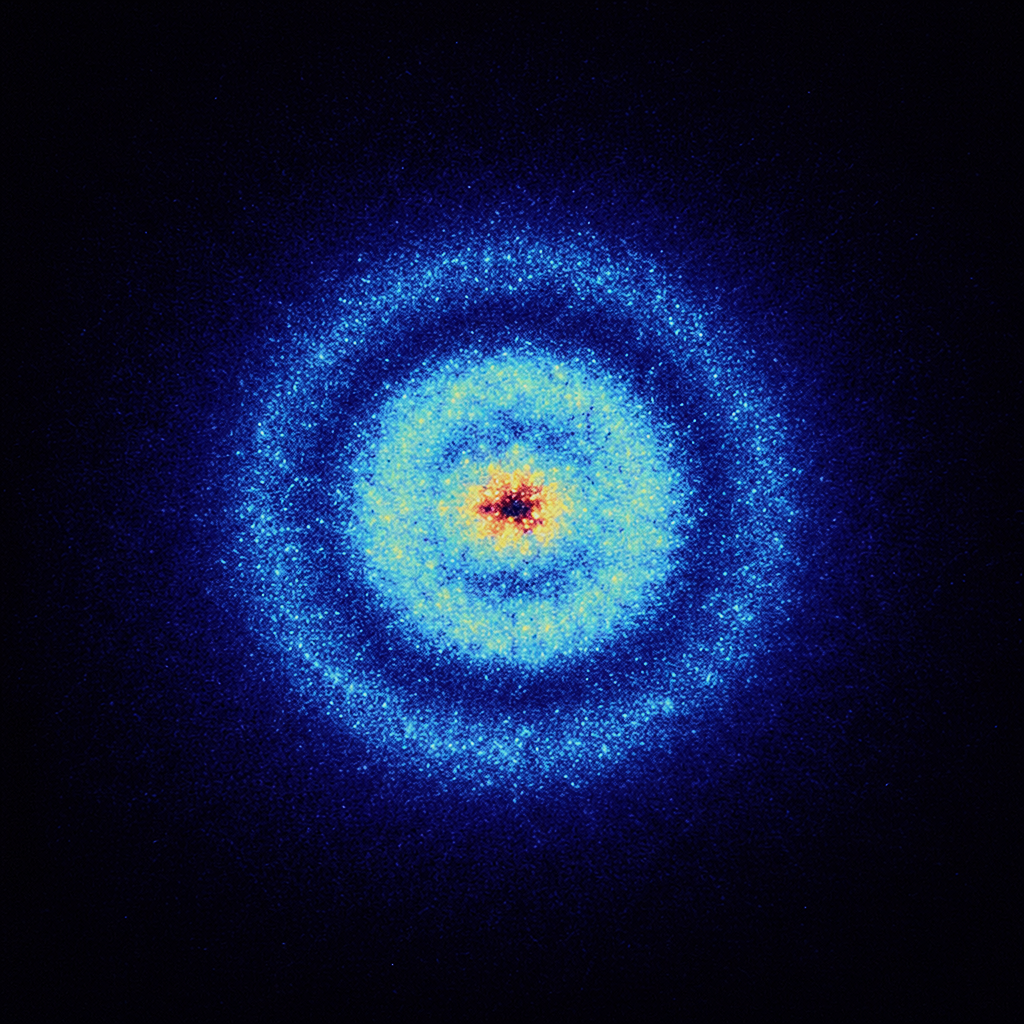
What an atom is
An atom is not a miniature solid sphere. It is a bound quantum system made of a compact nucleus and one or more electrons. Almost all of its mass sits in the nucleus, while most of its size is set by the region in which electrons can be found with different probabilities.
This is why the old picture of electrons as tiny planets is useful only as a historical stepping stone. In the modern description, electrons are not little balls on neat tracks. They occupy quantum states, and those states create orbitals: structured probability distributions with nodes, lobes, symmetry and energy levels.
How empty it really is
The scale gap inside an atom is staggering. The Bohr radius that characterizes hydrogen is about 5.29 × 10⁻¹¹ m, while the proton charge radius is about 8.4 × 10⁻¹⁶ m. That puts the characteristic atomic scale roughly tens of thousands of times larger than the proton itself.
A good mental picture is this: if the nucleus were shrunk to a grain of sand at midfield, the electron cloud would extend roughly to the scale of a stadium or sports field around it. This is also where the atom parts ways with the geometric idea of a point. A point has zero dimensions: it marks position only, with no size, no volume and no internal structure. An atom, by contrast, belongs to the three-dimensional physical world. Its nucleus may be extraordinarily small and its electron cloud diffuse, but together they still define a real spatial extent. The atom is therefore not “filled” the way a marble is filled. It is mostly structured space — shape imposed by fields, charge, quantization and probability.
Where classical physics stops working
Classical physics gets one crucial thing right: opposite charges attract, so a negatively charged electron is drawn toward a positively charged nucleus. But if you try to describe the atom purely classically, the picture fails. A classically orbiting electron would radiate energy, lose altitude and spiral into the nucleus.
The boundary is exactly where the atom becomes a quantum object rather than a mechanical miniature solar system. At atomic distances, electrons are described by wavefunctions, quantized energies and uncertainty relations. The transition is conceptual: classical intuition still helps with electric attraction, but the stable architecture of the atom only appears once quantization enters the story.
Why the atom does not collapse
The electron does not collapse into the nucleus because an atom is not a miniature solar system. In the quantum world, the electron is not a tiny ball moving on a fixed path, but a spread-out state — a wave of probability.
If you tried to force the electron into the very center, into an extremely small region near the nucleus, its position would become very precise. But according to Heisenberg’s uncertainty principle, that would cause a sharp rise in the uncertainty of its momentum — and in practice, a sharp rise in kinetic energy. In other words: the more tightly you squeeze the electron, the higher the energy cost becomes. This is often called quantum pressure — not a separate force, but a resistance that comes from the laws of quantum mechanics.
So the atom is a balance between two tendencies. On one side, the positively charged nucleus pulls the electron inward through electromagnetism. On the other, quantum mechanics does not allow the electron to be compressed without paying a huge energy cost. The most stable state is therefore not “at the center,” but the state of minimum total energy — the ground state.
That is why the electron does not fall into the nucleus: not because something mechanically holds it up, but because full collapse would require more energy, not less. And nature always favors the lowest possible energy state.
Why matter feels solid anyway
If atoms are mostly open space, why does a wall feel solid? Because “solid” is not the same thing as “densely filled.” When electron clouds from different atoms are pushed together, electromagnetic repulsion rises sharply. In many-electron systems the Pauli exclusion principle also prevents electrons from all collapsing into the same quantum state.
What your hand experiences is not contact between hard miniature billiard balls. It is resistance: quantum states, electromagnetic forces and exclusion effects refusing to let matter occupy the same configuration. The everyday sensation of solidity is therefore a triumph of invisible structure, not of classical packed substance.
The strange shape of the electron cloud
The electron cloud is not fog in the ordinary sense. It has geometry. Some orbitals are spherical, some have dumbbell-like lobes, some have more intricate multi-lobed structure, and many contain nodal surfaces where the probability drops to zero.
Chemistry is born from this architecture. The periodic table, bonding, angles between atoms, conductivity and color all emerge from how electrons occupy allowed quantum states and how those states overlap between atoms. In that sense, nearly all visible matter is an aftereffect of atomic wave mechanics.
What science can see today
Modern experiments still do not give a simple ordinary photograph of a textbook atom as if it were a tiny pebble under a lamp. But they do increasingly resolve the consequences of atomic quantum structure. Recent electron-microscopy work has directly imaged projected electron-density-related contrast in materials, and MIT researchers reported the first images of individual atoms freely interacting in space.
That is part of what makes the atom so extraordinary. It is one of the oldest ideas in science, yet the frontier is still moving: not because we doubt atoms exist, but because our tools keep getting good enough to reveal more of their hidden internal logic.
Why the atom is still a “wow” object
A grain-sized nucleus. A field-sized cloud. Almost all the mass in the center, almost all the size in the cloud. A system that classical physics says should fail, yet quantum mechanics turns into the foundation of everything from salt and steel to stars and semiconductors.
The atom is remarkable precisely because it is not intuitive. It looks empty but is not trivial. It looks unstable classically but is deeply stable quantum mechanically. It seems small beyond imagination, yet its internal rules scale upward into chemistry, biology, electronics, materials science and civilization itself.